
Build next year's cloud budget from allocated history
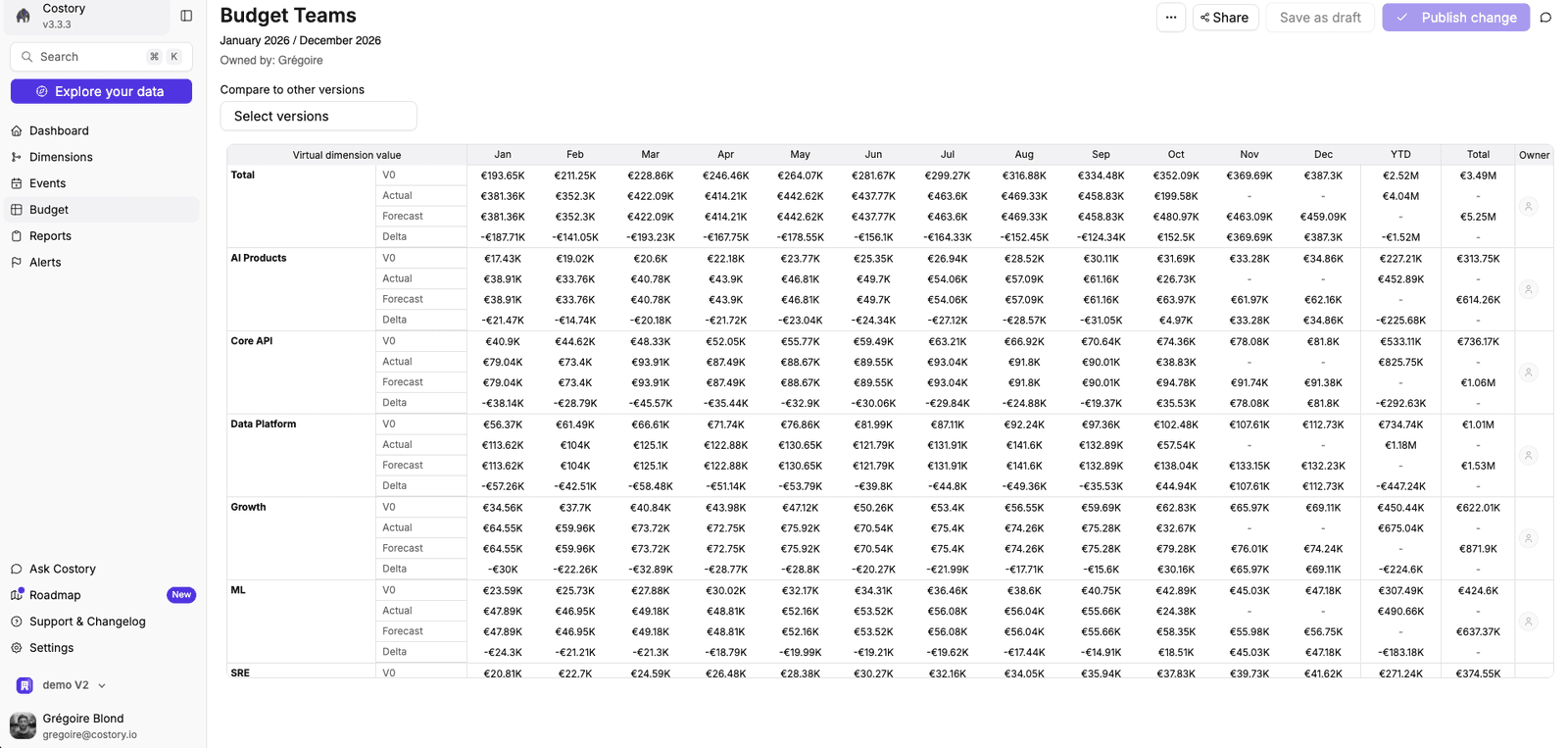
Start budget season from 12 months of allocated cost per team, growth trends and known changes, with every version tracked.
Runs in
Claude · Slack
First optimization recommendation
The next day
ROI
Pays for itself with the first recommendation you act on
Playbook
What the agent does
From what Costory notices to what you decide. Costory suggests the next step in conversation, and you decide whether to go ahead.
Costory notices
Budget season starts.
Costory investigates
01
Pull the history
12 months of allocated cost per team and product.
02
Add drivers
Growth metrics and planned changes from a Google Sheet.
03
Claude drafts
A proposed budget per team, with the assumptions written out.
04
Version it
Budgets support multiple versions, so revisions stay tracked.
Where you see it
Claude
You decide
Finance and team leads agree on each line.
Why it matters
Annual cloud budgets are built from last year's total plus a percentage. Teams don't recognize their numbers, and nobody owns them.
Who it’s for
Finance, VP Engineering, FinOps leads
Where it runs
Claude · Slack
What you get
What lands in front of your team
Owned budgets
Built per team, from their own history.
Explicit assumptions
Every number has a reason.
Tracked revisions
Versions through the year.
Sources and assistants
What it connects
Data sources
Example prompts
Or drive it yourself
Draft
Using the last 12 months of allocated cost per team and our growth assumptions sheet, draft next year's monthly budget per team, with assumptions.
FAQ
Questions about this playbook
How are forecasts generated?
Costory forecasts end-of-month values for each budget line with TimesFM by Google, and alerts can use actual or forecasted thresholds.
How long does this playbook take to set up?
Connecting your billing data and the Costory MCP takes under 30 minutes with Terraform or CloudFormation. The playbook itself takes minutes: pick the scope, the trigger and the Slack channel. The first billing data lands the next day, and the agent starts from there.
Can we adjust what the agent does?
Yes. You choose the trigger, the scope (team, service, environment), the channel and the format, and you can pause or change it at any time.
Does Costory change anything in our cloud accounts?
No. Costory reads billing exports and the metrics you connect, and has no write access to your cloud. Actions it takes create Costory objects only: alerts, reports, dashboards and events. Your team stays in control of every change.
Step-by-step guide in the Costory docs
Related playbooks
Run these alongside it
Costory notices
The 3rd of every month.
Monthly budget vs actual review with engineering leads
A ready-made dashboard and monthly report with target, actual, forecast and delta per team, for the VP Infrastructure review.
See the playbook
Costory notices
The forecast for a team moves materially.
End-of-month cost forecast per team, before the invoice
See where each team will land at month end, based on a forecast model, and investigate drifts while there's still time.
See the playbook
Costory notices
Monthly, and when runway drops below three months.
Track cloud credits and runway
Follow credits received and consumed per provider and estimate when they run out, so the switch to paid usage is planned.
See the playbook

Put this playbook on call
Included in every plan, from €250/month. 30-day free trial: connect in under 30 minutes, get your first optimization recommendation the next day.
First optimization recommendation
The next day
ROI
Pays for itself with the first recommendation you act on
Setup
About 30 minutes
Data residency
EU
Access
Read-only on your cloud